.jpg)

How Can Vegans Benefit From Reading Sun Cheese?
Updated: Aug 7
Co-authored by Keira Higgins and Siobhan Griffin.
It may seem contradictory for a vegan to read a book titled, Sun Cheese: Lessons From Regenerative Farming That Can Help You Rewrite Your Future. Spoiler: it's not about cheese. The real story aligns with some of the core principles behind why vegetarians, vegans, pescatarians, and others have chosen to adjust their diets in the first place. In the book, I don't tell anyone what to eat. Instead, I share an ecological perspective that encourages holistic thinking and explores solutions that can be applied in all facets of our lives.
You may relate to and be inspired by aspects of my book if:
You or someone you love lost a home to wildfire.
Your neighborhood has flooded.
Your region is experiencing water-use restrictions.
You love animals, especially wildlife.
Many of you who are close to me know that my daughter has been a vegetarian since she was nine years old. Why? Simply put, she has a deep compassion for animals. On our organic farm in upstate New York, she saw our cows every day, so when some of those cows were sent to the slaughterhouse for beef, she decided she didn't want to eat them. Even at a young age, she was also keenly aware of the inhumane and unsustainable practices of feedlots and factory farming, so eating store-bought meat was never going to be an option. Becoming a vegetarian was the obvious choice because it aligned with her values.
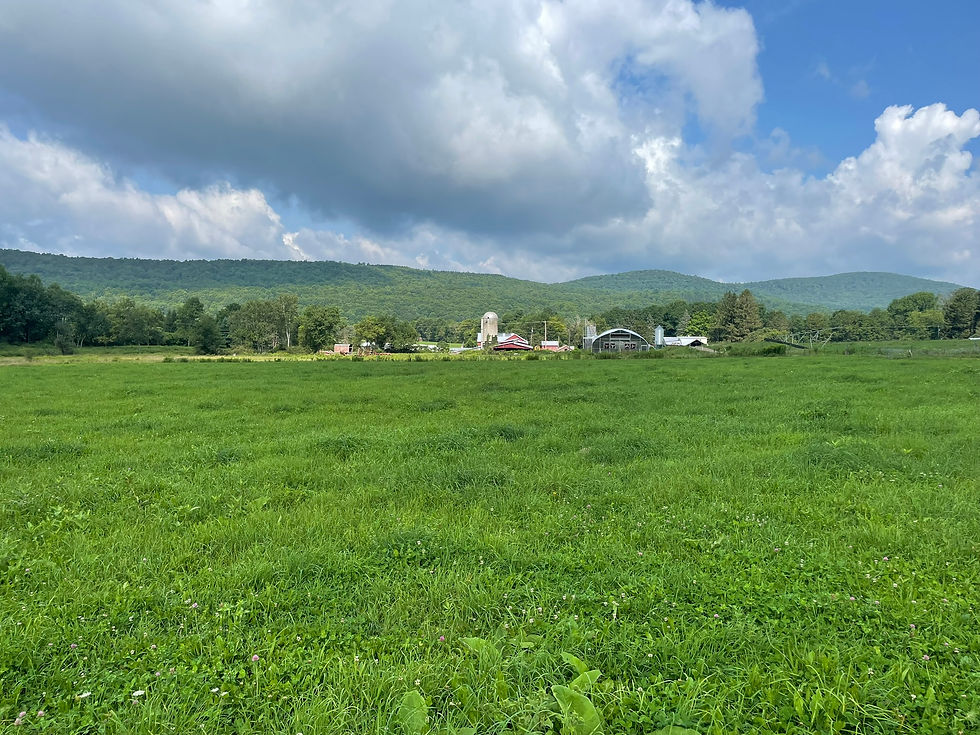
At Raindance Farm, we implemented holistic planned grazing to encourage greater plant diversity in our pastures while increasing wildlife abundance. Our cows grazed on pasture, helping to build soil, increase biodiversity, and produce high-quality milk that tasted incredible. And what do you do with great-tasting milk from cows that are responsibly caring for the land? Cheese, of course! We began making farmstead cheese at Raindance Farm in 2007 to provide a healthy option for both people and the land. In this case, the cows were the middleman. The sun was really at the heart of growing the diverse forage the cows enjoyed. Hence, Sun Cheese.
What we witnessed at Raindance Farm is when things started to click: all ecosystems on Earth evolved with animals and plants together. When endangered Karner blue butterflies and ground-nesting bobolinks appeared on the farm, it made me wonder why these species, which evolved in prairie ecosystems, had come. It turns out that the closed-canopy forests surrounding Raindance Farm in New York State is not the pristine ecosystem that was there before people came. Something critical is missing: large wild animals.
Our region, like every other region on the planet, was once teeming with giant grazing and browsing animals. In the eastern United States, there were many species of giant ground sloths, some as large as African bush elephants, along with giant bison, mastodons, and mammoths. These animals fertilized the landscape, kept it highly productive, and maintained open woodlands by preventing trees from taking over. Trees and small forest areas were interspersed among grasslands across much of North and South America and Europe. These landscapes experienced less wildfire, while the countless symbiotic relationships among plants, animals, and fungi cooled local landscapes and, collectively, the planet.
When megafauna went extinct in the Americas around 11,000 years ago, ancient sediment cores began showing increased charcoal deposits, marking a shift from fire-resistant ecosystems to fire-prone ones. In natural grasslands and savannas, more carbon is safely stored below ground in the form of roots and soil organic matter. Aboveground biomass does not accumulate when enough grazing animals are present to consume it and recycle its carbon.
Unfortunately, today there are not enough wild animals to provide this ecosystem service. However, we do have abundant megafauna capable of performing many of these ecological functions: livestock. Instead of helping care for the land, much of our livestock is confined to feedlots, where their innate ability is lost. The result is increasing fuel loads for wildfire and declining biodiversity.
Some people already recognize the need to return livestock to the landscapes where they evolved. At Montserrat, Spain for example, a project is underway that uses livestock to open woodlands choked with flammable brush and shade loving trees. The people managing this project are helping restore these landscapes by taking on the ecological role once filled by megafauna using the tools of chainsaws and managed grazing. After all, humans are megafauna too. They have arrived at a point in history when they can begin what I call the Restoracene by trying to give nature space to self-organize again into a fire resilient landscape.
Holistic management of forests to support native plants and animals is NOT the same as simply spending vast sums of money to mechanically thin stands of forestry, chip the wood and burn all the carbon in it back into the atmosphere. Simple mechanical thinning can cost over $3,000 an acre and doesn't address the root cause of the higher incidence of wildfire - browsing and grazing megafauna are absent. The expensive mechanical process will only have to be repeated regularly. If holistic rewilding is implemented instead, it is a long term solution that can pay for itself while putting the carbon captured by trees underground in the form of soil carbon where it will be safe from wildfire and can help cool the planet. The ultimate goal in North America should be to create habitat that will allow wild herds of elk, deer, pronghorn antelope, and bison to go forth and multiply.
This is an opportunity to return people to the land as well. Once trained in holistic management, people can restore vast landscapes using the tool of holistic managed grazing of livestock and produce habitat for wild megafauna like bison. As the numbers of wild megafauna grow beyond the carrying capacity of a restoration project, animals can be transferred or sold to support other restoration efforts. The livestock can also be harvested sustainably to help fund restoration. Properly managed livestock, acting as proxies for once-abundant wildlife, can sequester vast amounts of carbon deep within the soil while helping protect communities from wildfire.
My daughter's compassion for animals extended beyond her diet. While attending university, she joined 15 members of the women's cross-country team to complete a 1,400-mile, eight-day relay run from Auburn University in Alabama to the Rochester Institute of Technology (RIT) in March 2015 to raise awareness for tiger conservation. The event, known as the Tiger Trail, honored the mascots shared by the partner universities while drawing attention to the need for tiger conservation. Whether through her dietary choices or that remarkable relay run, my daughter has demonstrated that solutions can take many forms while contributing to broader ecological goals.
Many vegetarians and vegans are already aware of the inhumane and unsustainable practices associated with feedlots and factory farming. But what if that same passion could also be extended to rewilding? Solutions could include working with other concerned citizens to restore landscapes in your own community. Importantly, Sun Cheese encourages that successful rewilding must include megafauna if ecosystems are to fully benefit. These can be holistically managed recovering wild herds, holistically managed livestock (some are also megafauna), or both. Vegetarians and vegans already have a head start because of their mindfulness toward animals and the environment. I hope Sun Cheese inspires even more holistic thinking and meaningful action.

Comments